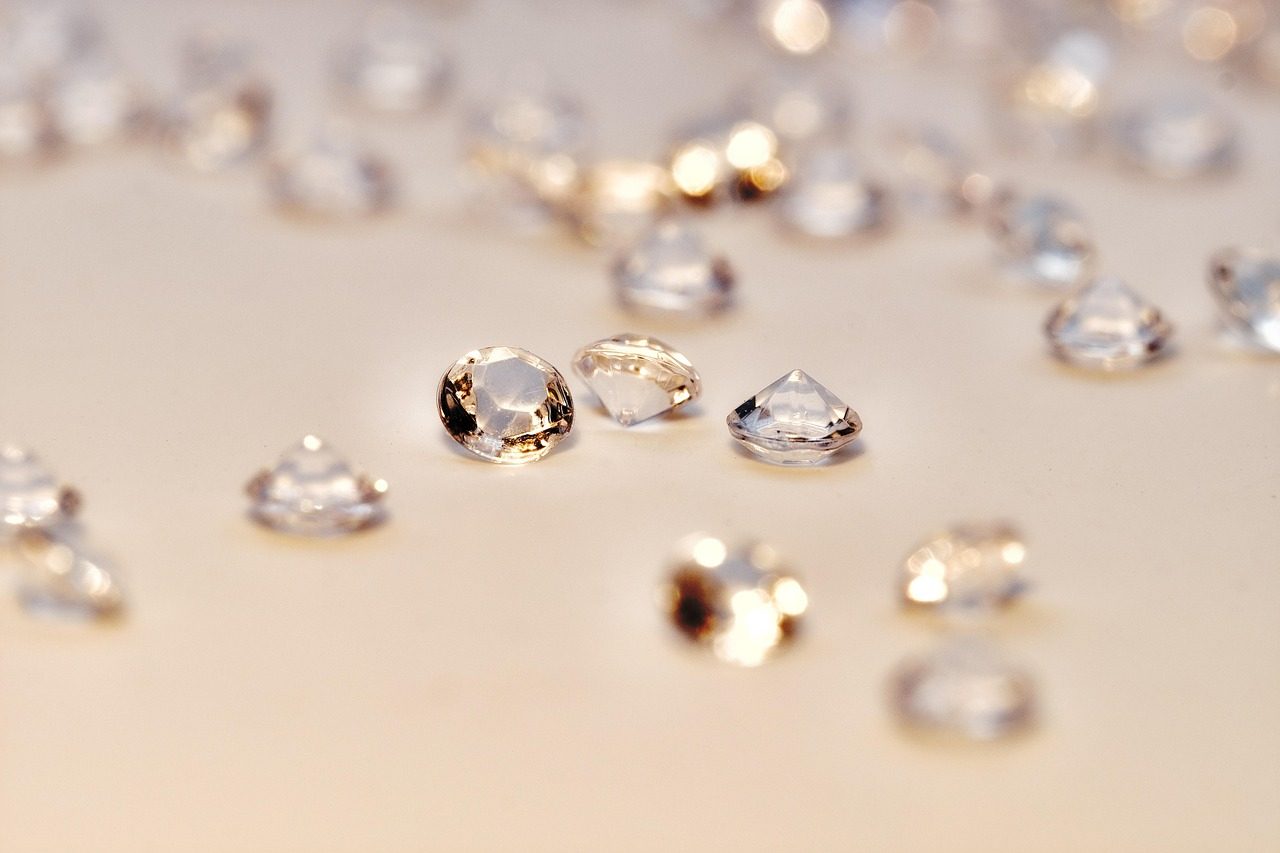
There is a specific kind of disappointment that comes from buying a piece of crystal jewellery, wearing it for two years, and noticing that the stones have gone dull and slightly grey. It is not a defect. It is the material behaving exactly as designed, and almost nobody explains it at the point of sale.
This guide is the explanation. It covers what Swarovski crystal physically is, where the money in the price actually goes, which of their lines are worth the premium and which are not, how to judge a piece in your hand in about thirty seconds, and the four things that will destroy it faster than wear ever will.
Two disclosures before we start, because this site is honest about how it pays for itself. Some links in this article are affiliate links, which means we earn a commission if you buy through them, at no extra cost to you. And we have no relationship with the brand beyond that: no press samples, no sponsored placement, no approval over what we write. Our full policy is on the affiliate disclosure page. If the honest answer is "this is not worth your money", that is what follows.
What it is, stated plainly
Swarovski crystal is glass. Not "a crystal that behaves like glass" — glass, formulated to a high refractive index, coloured in the melt, cut on precision machines, and polished.
The company was founded in 1895 in Wattens, Austria, by Daniel Swarovski, on a machine for cutting crystal beads more accurately than anyone could by hand. That origin explains everything about the product. It is a manufacturing business that happens to make beautiful objects, not a mining business that happens to make jewellery.
Three physical facts follow from that, and all three matter when you decide what to pay.
It is amorphous. Glass has no crystal lattice. There is no grain, no cleavage plane, no direction in which it splits. That is why it can be moulded into shapes that a mineral could never hold, and it is also why a chipped crystal cannot be repolished the way a chipped quartz can — there is no structure to work with, only a surface.
Its optical properties come from composition and cut, not from nature. A high refractive index makes light bend sharply at the facets; high dispersion splits that light into colour at the edges. Both are engineered. There is no rarity argument to make here, which is why the price is a manufacturing and brand price rather than a commodity price.
Most of the stones in jewellery are foil-backed. A thin metallic coating on the pavilion reflects light back through the stone so that it appears bright from the front. Without the foil, a small crystal in a closed setting looks like what it is: a piece of glass in a hole. The foil is also the component that fails first, and we will come back to it.
If you want the mineralogical side of this comparison — what quartz actually is, and why the word crystal covers both — that is in our guide to what crystal means.
What changed when the lead came out
For most of the twentieth century, the sparkle in good crystal glass came from lead oxide. Lead is heavy, it raises the refractive index, and it makes glass soft enough to cut and polish to a sharp edge.
That changed in the early 2010s. Restrictions on lead in consumer articles, plus concern about lead leaching in glassware, pushed the major producers to reformulate. Swarovski moved its production to a lead-free composition and markets it under its own name. The result meets the relevant limits, and the material is safe to wear against skin in the way any glass is.
The optical cost is real but small: lead-free formulations have a slightly lower refractive index, so a modern stone is marginally less brilliant than a 1970s one of the same cut. The company's answer was to cut and polish more precisely, which is why modern stones often look sharper at the facet edges even where they are technically less dispersive.
The practical consequence for a buyer is worth stating because it is counter-intuitive: an older piece is not automatically a better piece. Vintage crystal has lead in it and a warmer, deeper sparkle that some collectors prefer. It also has forty years of accumulated damage, plating wear and possibly a failed foil. Modern crystal has a slightly cooler look and a much better chance of arriving intact. Neither is superior; they are different materials from different eras, and pricing should reflect condition rather than age.
Where the money actually goes
We are not going to quote prices here. They change every season, they differ by market, and the number at checkout is the only one that means anything. What does not change is the structure underneath the price, and that is the part worth understanding.
Four things make up what you pay.
Cutting tolerance. This is the real product. A crystal cut to a fraction of a degree across thousands of stones means every stone in a necklace catches light at the same angle, so the piece reads as one object rather than as a collection of beads. That consistency is expensive to achieve and it is genuinely visible when you compare a good piece with a cheap one side by side.
Colour consistency. Colour in glass is set in the melt, batch by batch. Matching a new stone to a five-year-old piece is a manufacturing problem, not a design one, and it is the reason people who build sets over time stay with one house. If you have ever tried to match a replacement bead from a different supplier, you know what this is worth.
Setting and finishing. The labour in setting two hundred stones, the plating on the metal, the quality of the clasp, whether the pin findings are soldered or merely glued. This is where cheap crystal jewellery and good crystal jewellery separate most visibly, and it is the part that decides whether the piece lasts three years or fifteen.
The brand. A real and substantial component. You are paying for a name that carries a certain floor of quality, for retail space, for packaging, and for the fact that the piece can be given as a gift without explanation.
If you want to see how that structure plays out across the current range — the metal, the setting style, which pieces are built for daily wear — the collection is here. Look at the setting before you look at the price; it tells you more.
The honest summary is that the first three components are worth paying for and the fourth is a matter of taste. A piece with tight cutting, even colour and a proper setting is good value at a fair price whatever the logo says. A piece with those qualities and a logo is good value at a higher price if the design is something you actually want. A piece with a logo and a glued setting is a logo.
What it does better than almost anything at the price
It would be easy, and wrong, to write this piece as a takedown. There are three things crystal glass does better than the alternatives, and they are not small.
Uniformity at small sizes. Try to buy fifty matched 1.5mm round stones in a natural gemstone and you will spend months and a great deal of money. In crystal glass you can buy them by the thousand, identical, and replace one that falls out. This is why crystal dominates pavé-set costume jewellery and why no natural stone can compete in that specific application.
Colour range without a rarity premium. A saturated emerald green, a fuchsia, a cobalt, a pure black — in natural stones each of these is a specific material with its own supply constraints and its own price. In glass they are all the same product with a different oxide in the melt. If you want a colour because you like it rather than because it is rare, glass is the rational choice.
Consistency over time. As above. This is the underrated one. A jewellery wardrobe built over ten years from one crystal house will match itself. A wardrobe built from natural stones will not, because the supply changes.
There is a fourth, softer advantage that we would defend: crystal takes design risks that precious materials cannot. A three-inch flower, a bird with two hundred stones, a colour combination that no gemstone suite would attempt. Some of it is silly. Some of it is genuinely good design that would never be manufactured in gold and sapphire, because nobody could sell it at a price anyone would pay.
What it does not do
Four limitations, stated plainly, because they are the ones that produce disappointed owners.
It has no resale value. Crystal glass is not a store of value. There is no material floor underneath the retail price, no commodity market, and no meaningful secondary market for used fashion jewellery. A few discontinued collectible ranges have a collector following, but that is a niche hobby with its own rules, not an investment thesis. Assume the resale value is zero and you will never be disappointed.
The foil fails. This is the big one. The metallic backing on a crystal stone is a thin coating, and moisture gets under its edge. Perfume, sunscreen, hairspray, sweat, washing-up water. Once corrosion starts, the stone goes cloudy, then grey, then greenish, and there is no repair — the foil is inside the setting and cannot be replaced without destroying the piece. A necklace worn against bare skin in summer will show this first at the stones nearest the skin.
Plating wears through. Most pieces are plated base metal. Plating thickness is rarely published, and where it wears — the inside of a ring, the edge of a clasp, the back of an earring — the underlying metal shows. On gold-tone pieces this reads as a dull patch; on rhodium it reads as a scuff. There is no fix short of replating, which usually costs more than the piece.
Glued stones lift. A stone held by glue is held by one small patch of adhesive that expands and contracts at a different rate from the metal around it. Over years, and especially with heat and water, it lets go. A stone held by claws or a bezel can be tightened. A glued stone that falls out is a stone you have to match and re-glue, and matching is easier if you stay with one house — which is the argument for consistency made earlier, arriving from the other direction.
None of this is a reason not to buy. It is a reason to buy the right piece and to treat it as what it is: well-made fashion jewellery, not an heirloom.
The lines, and which one you are buying
The range is large and the naming changes, so rather than list product names that will be out of date by the time you read this, here is how to tell the categories apart by what is in front of you.
Crystal fashion jewellery. The core business. Base metal, plated, crystal set by glue or claws. This is where most of the design happens and where most of the volume is. Judge it on setting type and plating, not on stone count.
Sterling silver pieces. A smaller range, marked as such. The silver is worth something as metal, the plating problem disappears, and the piece will outlast a base metal equivalent if the setting is sound. If you intend to wear something for years, this is the tier to look at.
Created Diamonds. Laboratory-grown diamond — actual diamond, with the hardness and the gemmological properties of mined diamond, at a substantially lower price than mined. This is a completely different product from crystal glass and should be evaluated as a diamond purchase, not as a crystal one. Do not let the shared brand name blur the line; if you are comparing a crystal piece with a Created Diamonds piece you are comparing two different materials with two different sets of expectations.
Object and décor ranges. Figurines, ornaments, chandelier components. A genuinely separate market with its own collectors, its own secondary market and its own condition rules. If you are buying in this category, buy because you want the object.
The line that most often disappoints is the first one bought at the top of its price range. A base metal, plated, glued piece at a high price is a design purchase, and it should be made with your eyes open about the two-year horizon. The line that most often over-delivers is the silver range, which is quietly the best-value corner of the whole business.
How to judge a piece in your hand
Thirty seconds, four checks. This works in a shop and it works on a product page if the photography is good enough.
Look at how the stone is held. Claws or a bezel: the stone can be tightened and the piece can be repaired. A smooth metal rim with the stone sitting in a bed of adhesive: it cannot. On a pendant worn occasionally, glue is fine. On a ring or a bracelet, it is a countdown.
Look at the edges of the plating. The inside of a ring, the hinge of a clasp, the back of a drop earring. If the plating looks thin or uneven where the piece flexes, that is where it will go first.
Look at the setting from the back. If the back of the piece is open, you can see whether the stones are foiled and whether the foil is intact. On a new piece it should be bright and even. On a second-hand piece, any grey or green is a failed foil and the price should reflect it.
Check the closure. A lobster clasp with a solid trigger, a hinge that snaps rather than drags, a post that is soldered rather than pressed into the earring. Clasps are where cost gets cut invisibly and where a piece is lost.
If you want to run these four checks against the current range rather than in the abstract, the pieces are here — the product photography is clear enough on most items to see the setting from the front, and the metal is listed.
The four things that destroy it
In order of how often we see them.
Water, especially soapy water. Washing up, showering, swimming. Water gets behind the foil and behind glued stones, and detergent lowers the surface tension so it gets in faster. This is the single biggest cause of dead-looking crystal. Take the piece off before you put your hands in a sink.
Perfume and sunscreen. Both are solvents and both are applied to skin, which is where the jewellery sits. The standard advice — perfume first, jewellery last — is not fussiness, it is the difference between five years and fifteen.
Abrasive storage. Crystal at around 5.5 on Mohs will scratch itself and anything softer. A pile of necklaces in a drawer produces a network of fine scratches on every stone that touches another. Separate pouches, or a compartment box with dividers.
Ultrasonic cleaners. Do not. An ultrasonic bath will drive moisture behind the foil and can loosen glued stones, and it offers nothing in return because there is no dirt in the setting that a soft brush cannot reach. This is the one piece of standard jewellery advice that does not transfer.
For the general method, including how to clean pieces with mixed materials, see our cleaning guide.
When it is worth it
The honest verdict, in four cases.
Worth it: you want a specific look — colour, scale, a design that no precious material could deliver — and you accept a five-to-fifteen-year horizon. Crystal glass is the only material that can do certain things at a wearable price, and paying for good cutting and a sound setting is paying for the part that actually works.
Worth it: you are building a set over time and need stones that match. This is the strongest technical argument for staying with one house, and it is not marketing.
Worth it: a gift where the presentation matters and the recipient will enjoy the object rather than appraise it. That is a legitimate use of money and we are not going to be snobbish about it.
Not worth it: you are buying it as an investment, or as a substitute for a fine jewellery purchase you actually wanted. It will not hold value, it will not become an heirloom, and the stones will not last like a hard mineral. If what you want is a diamond, buy a diamond — lab-grown if the budget points that way — and read our guide to lab-grown versus natural first.
Not worth it: a high-priced piece in the base metal range with glued stones, bought for daily wear. The design may be lovely and the price will be for the design. That is a fine reason to buy something. It is not a reason to expect it to last.
The short version
Swarovski crystal is precision-cut lead-free glass, and the precision is the product. It is not a gemstone, it has no resale value, and it will not outlast a hard mineral — but nothing else matches it for colour consistency, small-stone uniformity and the ability to replace a single missing stone five years later.
Where the money goes: cutting tolerance, colour matching, setting and finishing, then brand. The first three are worth paying for. The fourth is a matter of taste, and a piece that is expensive only because of the fourth is a logo with a stone in it.
What kills it: water, perfume, abrasion in a drawer, and ultrasonic cleaners. What you should check before buying: how the stone is held, how the plating looks where the piece flexes, whether the back is open enough to inspect, and whether the clasp is solid.
Buy it as well-made fashion jewellery with a defined lifespan. On that basis it is good at what it does. Buy it expecting an heirloom and the foil will tell you otherwise within a few years.